
Project Overview: An Evaluation of Two Innovative Workforce Programs in Detroit
To build a stronger workforce, cities need to test new ideas and learn from what works. Detroit’s workforce development agency, Detroit at Work, hired MEF Associates to evaluate two innovative, ARPA-funded initiatives: JumpStart and Skills for Life. Our goal was to provide a detailed analysis of these programs to understand what worked, for whom, and what lessons could shape the future of workforce development in Detroit. We conducted a mixed-methods program evaluation based on retrospective program data from Detroit at Work, interviews with staff and community partners, and participant focus groups.
Our findings reveal a compelling story of rapid implementation and continuous program adaptation by staff, providing practical lessons for future initiatives.
Two Paths to Opportunity: The Program Models
This study evaluated two programs that connected over 2,600 residents with skill-building, supportive services, and employment search assistance.
JumpStart: A Flexible Journey for the Long-Term Unemployed
- The Idea: Provide a supportive ecosystem for Detroiters who had been out of the workforce for an extended period. The model combined mentorship from community partners, monthly stipends for stability, and flexible program tracks for education, job training, and employment placement support.
- Who It Helped: 1,842 Detroiters facing long-term unemployment who needed a supportive path to re-engage with the workforce on their own terms.
Skills for Life: Earn While You Learn
- The Idea: Offer immediate employment and income stability. The City of Detroit hired participants to work three days a week while spending two days in paid occupational training or educational programs.
- Who It Helped: 835 Detroiters who wanted to gain a new credential without sacrificing a paycheck.
A Snapshot of Participant Outcomes
Our analysis highlighted program engagement metrics and key outcomes for each program.
JumpStart: Re-engaging the Long-Term Unemployed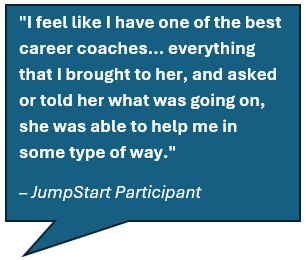
- Meaningful Employment: Despite facing significant barriers, 60% of participants reported securing a job after JumpStart.
- Essential Skills Attainment: Of the 840 participants enrolled in a job training course, 62% completed training. In addition, participants praised the program’s Career Readiness and Digital Literacy courses.
- Financial Assistance and In-kind Support: Over $10 million in monthly stipends were distributed for an average of 12 months, and 75% of participants received in-kind support, including laptops and transportation aids.
Skills for Life: Building Skills and Income
- Pathways to Better Wages: Almost half of engaged participants secured post-program employment, though this varied by type of training (e.g., 81% for CDL-B vs. 27% for Carpentry). Nearly two-thirds of employed participants landed jobs paying $17 per hour or more, a key benchmark for a living wage.
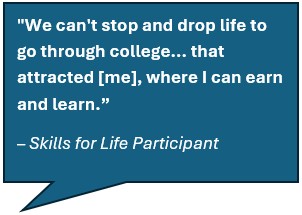
- High Training Completion: An impressive 76% of participants completed a job training program they enrolled in, from CDL to heavy equipment operation.
- Program Graduation: Participants with a high school diploma or some college had higher program completion rates (73% and 81%, respectively) than those without a high school diploma (37%).
- Educational Skill Gains: A subset of participants in education programs saw their math scores improve by an average of 1.4 grade levels, and reading scores improve by an average of 0.9 grade levels.
A Blueprint for the Future: Key Lessons from the Evaluation
These two programs, representing substantial new investments, were largely designed from the ground up and implemented rapidly. This approach required intricate coordination between Detroit at Work, City departments, and community-based partners. Our evaluation identified some clear successes and lessons that can act as a blueprint for continuing to adapt and evolve future Detroit workforce initiatives.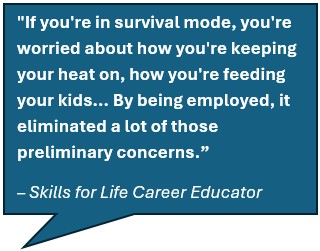
- Career readiness is an essential component. Both programs offered courses that introduced participants to workforce-related skills-building, such as communication, financial coaching, and soft skills instruction. Participants in both programs achieved high completion rates, and both participants and providers valued the courses. Providers recommended intermittent refreshers throughout the program.
- Stability can act as a springboard. The “earn-and-learn” model of Skills for Life was a game-changer for many participants. A stable paycheck is one of the most powerful tools for helping someone focus on their future. However, future programs can more intentionally integrate or align the content of the jobs and training programs offered.
- Financial assistance needs a clear theory of change. To effectively support participants, the payment design and structure of financial assistance must be intentionally aligned with program goals and participant needs. Consistent stipends can support participants’ financial stability, reduce stress, and meet basic needs. Alternatively, payments tied to program milestones or goal achievement can incentivize program participation, and larger barrier removal payments can improve stability in transportation, childcare, or housing.
- Training programs must be aligned with employer needs. Earning a certificate is only half the battle, and connecting program graduates to viable employment opportunities remains a challenge. We found a need to continue strengthening the connection between training providers and employers to ensure training programs align with employer needs and build skills sufficient for employment in related fields.
- Successful community partnerships are built on clarity and structure. Our study showed that for community mentors and career coaches to be successful, they need sustainable funding, realistic caseloads, and clear expectations around roles and communication channels.
Dive Deeper
This summary highlights the key takeaways from our evaluation. We invite partners, community members, and city leaders to explore the rich findings in the full report to help shape the next generation of workforce development in Detroit and beyond.
Get the Executive Summary (PDF)